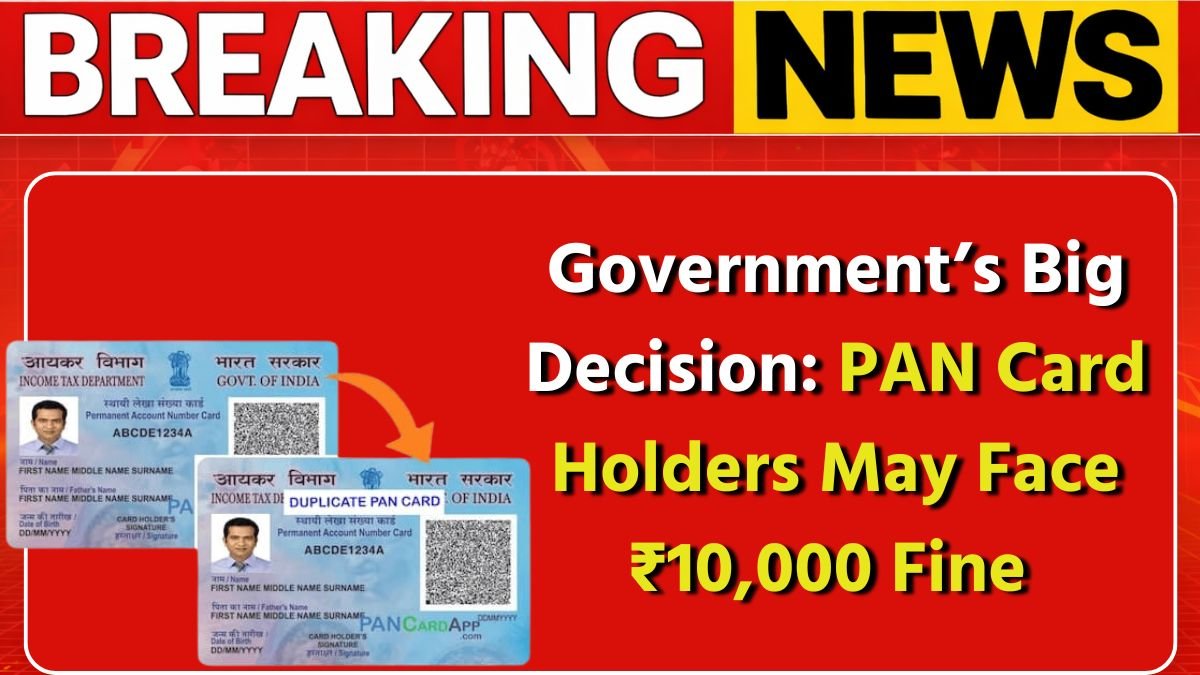
There’s a quiet fear many Indians carry without even realizing it. It sits inside our wallets, inside our phones, inside a small blue card we rarely think about—our PAN card.
We use it for banks, for taxes, for investments, for jobs. Yet one small mistake, one ignored update, or one missed deadline can now cost you up to ₹10,000.Let’s break this down calmly, clearly, and honestly—so you don’t become one of those people who finds out only after getting a notice.
PAN Card Rules Update 2025: What Changed and Why It Matters
The Income Tax Department has updated several PAN-related rules in 2025. These rules are not only for business owners or high-income taxpayers. They apply to students, salaried employees, freelancers, housewives, retirees, and NRIs.
What this really means is simple: PAN is no longer just a tax card. It has become your financial identity.
Aadhaar Linking Is Now Non-Negotiable
The government has made PAN–Aadhaar linking compulsory. This is no longer a suggestion. It is a requirement.

If your PAN is not linked with Aadhaar, your PAN becomes inactive. And once it is inactive, you cannot file income tax returns, you cannot open a new bank account, you may face higher TDS deductions, and many digital services stop working automatically.
To reactivate it, you must link Aadhaar and pay a penalty. The total fine can go up to ₹10,000, depending on how late you are. After payment and linking, the PAN usually becomes active again within about 30 days.
Here’s the hard truth: most people don’t check their PAN status until something breaks. By then, stress has already entered the picture.
PAN Card Is Now a Universal Business Identity
For business owners and professionals, PAN has become even more powerful. One PAN now connects GST, EPFO, ESIC, bank accounts, licenses, and compliance records.This reduces paperwork. But it also means one mistake spreads everywhere.
If your PAN details are wrong, your GST filings, employee records, and banking compliance may all face issues together. The system is more efficient now, but it is also stricter.

New KYC Rules Every PAN Holder Must Follow
This is where many people unknowingly fall into trouble.
Your PAN must reflect your real, current details. Your address should be correct. Your mobile number should be active. Your email ID should be reachable. Your name, date of birth, and personal details must match Aadhaar and bank records.
Even your occupation or business category matters now.
If your PAN data does not match with Aadhaar or banking KYC, your PAN can be flagged or temporarily suspended. Transactions may fail. Refunds may get stuck. Verification processes may slow down.
It feels unfair when it happens. But the system does not ask for feelings. It only checks data.

PAN Is Mandatory for High-Value Transactions
The government is now tracking financial transparency more closely. PAN is required for large transactions such as high bank deposits, cash withdrawals beyond limits, expensive jewellery purchases, large credit card payments, investments in mutual funds, stock market trading, and foreign remittances.
Without PAN, or with an inactive PAN, these transactions either fail or get reported automatically.
And once something is reported, questions follow.
Why the ₹10,000 Fine Exists
This fine is not a punishment for being poor or busy. It exists to force compliance in a digital financial system. The government wants every rupee linked to a verified identity.
- The problem is not the rule. The problem is ignorance.
- Most people don’t know they are already in violation until they receive a notice or face a blocked service.
